Tile Weight Calculator
Last updated
Your assembly
Denser than ceramic — heavier per square foot.
Total installation weight
984 lbs
- Tile weight
- 4.5 lbs/sq ft
- Mortar + grout
- 1.2 lbs/sq ft
- Underlayment
- 2.5 lbs/sq ft
- Assembly total
- 8.2 lbs/sq ft
- Tile alone (~40 lb boxes)
- ~14 boxes
Within the usual 10 lbs/sq ft rule of thumb for wood-framed floors.
Save this calculation in the free app
Smart Tile Calculator keeps your tile jobs on your phone, offline. On iPhone? It's inside Roofing Calculator & Estimator.
Next step for this job
984 lb on 120 sq ft is 8.2 lb per sq ft. Weight is half the question; whether the floor flexes is the other. Check your joists in the floor deflection calculator (L/360 for porcelain, L/720 for stone).
People also calculate
Tools the pros use for this job
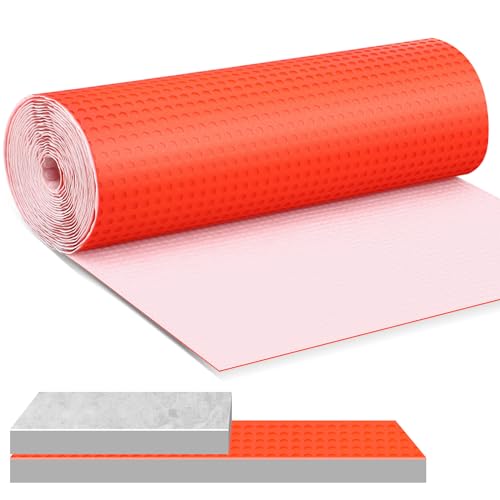
Uncoupling Membrane
Weighs ~0.3 lb/sq ft against ~2.5 for 1/2 in cement board, the biggest weight saving on an upstairs floor.
Suction Cup Lifter

Tile Vibration Leveling Machine Compatible with De-walt 20V Battery, Cordless Tile Vibration Machine Installation Tool 150W Tiler Vibrator with 8 Speed, Suction Cup, Digital Display (Tool Only)
$59.99
Check price on AmazonHeavy porcelain and stone are set safely with suction, not fingers.
Hand Truck

Leeyoung Folding Hand Truck and Dolly,309 lb Capacity Aluminum Portable Cart with Telescoping Handle and PP+EVA Wheels
$69.99
Check price on AmazonTile boxes run 40-75 lb each; move the delivery a stack at a time, not box by box.
As an Amazon Associate I earn from qualifying purchases.
Prices as of Oct 10, 2026, 6:33 AM UTC. Product prices and availability are accurate as of the date/time indicated and are subject to change. Any price and availability information displayed on Amazon.com at the time of purchase will apply to the purchase of this product.
Tile weight per square foot, by material and thickness
| Material | 1/4 in | 3/8 in | 1/2 in | 3/4 in (20 mm) |
|---|---|---|---|---|
| Glazed ceramic | 2.5 lb | 3.8 lb | 5.0 lb | 7.5 lb |
| Porcelain | 3.0 lb | 4.5 lb | 6.0 lb | 9.1 lb |
| Marble | 3.5 lb | 5.3 lb | 7.1 lb | 10.6 lb |
| Travertine | 3.1 lb | 4.7 lb | 6.3 lb | 9.4 lb |
| Granite | 3.5 lb | 5.3 lb | 7.1 lb | 10.6 lb |
| Slate | 3.6 lb | 5.5 lb | 7.3 lb | 10.9 lb |
| Glass | 3.2 lb | 4.8 lb | 6.5 lb | 9.7 lb |
Computed from material density and thickness: weight per sq ft = density (lb/cu ft) x thickness (ft). Real tiles vary with body composition and glaze, so treat these as the middle of a range rather than a spec.
How much does a box of tile weigh?
| Sq ft per box | Ceramic (3.5 lb) | Porcelain (4.5 lb) | Stone 1/2 in (7 lb) | Porcelain paver (9 lb) |
|---|---|---|---|---|
| 8 sq ft | 28 lb | 36 lb | 56 lb | 72 lb |
| 10.76 sq ft | 38 lb | 48 lb | 75 lb | 97 lb |
| 12 sq ft | 42 lb | 54 lb | 84 lb | 108 lb |
| 13.5 sq ft | 47 lb | 61 lb | 95 lb | 122 lb |
| 15.5 sq ft | 54 lb | 70 lb | 109 lb | 140 lb |
| 16 sq ft | 56 lb | 72 lb | 112 lb | 144 lb |
Check the sq ft printed on the box; 10.76 sq ft is 1 m² (metric-packed tile). Most boxes are packed to stay under ~75 lb.
Will the floor take it?
Two different numbers matter here and they are easy to confuse. Dead load is the permanent weight of the building and everything fixed to it, including your tile assembly. Live load is everything that moves — people, furniture, the bath when it is full. Residential floors are designed for both, and the tile you are adding comes out of the dead load allowance.
The rule of thumb for a wood-framed floor is that a tile assembly under about 10 lb per square foot is unremarkable, and anything above it deserves a look at the framing before you start. That is a screening test, not an engineering answer. What actually decides it is the joist size, the span, the spacing and the species — and on a stone floor over a long span, or a second-storey bathroom with a stone-clad shower, it is worth having someone check rather than assuming.
Deflection matters more than raw weight for whether the tile survives. A floor can be strong enough to carry stone and still flex enough to crack it, because tile is rigid and does not bend with the joists. The industry limit usually quoted for ceramic and porcelain is L/360 — the floor may deflect no more than the span divided by 360 — and natural stone wants L/720, twice as stiff. A floor that feels bouncy underfoot is telling you something before any tile goes down.
Where the weight actually is
People weigh the tile and forget the rest of the sandwich. On a typical porcelain floor the tile is roughly half the assembly: thinset and grout add a few pounds per square foot, and cement backer board adds several more again. Swapping backer board for an uncoupling membrane is the single biggest weight saving available on a wood-framed floor, which is part of why it is specified so often on upper storeys.
The other place weight shows up is delivery day. Tile is sold in boxes that are heavy for their size, and a pallet for an average floor is more than most vehicles are rated to carry. Work out the box count first, check where the pallet can be set down, and if the job is upstairs, plan how the boxes get there before they arrive on the driveway.
Size the layers with the backer board calculator, the thinset calculator and the grout calculator, and if you are working with large-format tile the large-format calculator covers the flatness requirements that come with it.
Heavy tile on a wood-framed floor also needs stiff joists: the floor deflection calculator checks a joist floor against L/360 for porcelain or L/720 for natural stone, and if you are adding an uncoupling membrane, the DITRA calculator counts the rolls and thin-set bags.
Do this math on the job site — in the free app
Smart Tile Calculator for Android: offline, in your pocket, free.
How this calculator works
We add the tile's own weight, ~1.2 lbs per sq ft of thinset and grout, and your chosen underlayment (cement board adds ~2.5 lbs/sq ft; a modern uncoupling membrane only ~0.3). The total is what the structure carries and what gets delivered.
Rule of thumb for wood-framed floors: keep the whole tile assembly under ~10 lbs per sq ft unless a pro has checked the joists. Natural stone over 15 lbs/sq ft usually requires an engineer's sign-off and stiffer framing (L/720 deflection, not the standard L/360).
Frequently asked questions
How much does porcelain tile weigh per square foot?
Standard 3/8 in porcelain weighs about 4.5 lbs per sq ft, glazed ceramic about 3.5, and 3/4 in porcelain pavers about 9. Installed on thinset (about 1.2 lbs) and 1/2 in cement board (about 2.5 lbs), a porcelain floor carries roughly 8.2 lbs per sq ft.
How much does ceramic tile weigh per square foot?
Standard 3/8 in glazed ceramic weighs about 3.5 lb per sq ft, a little lighter than porcelain (4.5 lb) because its body is less dense. Thin 1/4 in ceramic wall tile is closer to 2.5 lb per sq ft. On thinset and an uncoupling membrane, a ceramic floor adds about 5 lb per sq ft of load.
How much does a box of tile weigh?
Most boxes are packed to 40–60 lbs. A box of 12x24 porcelain holding 16 sq ft weighs about 72 lbs at 4.5 lbs per sq ft, which is why heavy porcelain often ships 6 tiles to a box instead of 8.
Can my upstairs floor handle tile?
Usually yes for ceramic and standard porcelain with a membrane — that assembly runs about 5–6 lbs per sq ft, well within residential design loads. Heavy stone or thick pavers are where you need a structural check.
How heavy is a pallet of tile?
A full pallet of 12×24 porcelain typically holds 40–50 boxes of about 16 sq ft each, so 640–800 sq ft at roughly 4.5 lbs per sq ft: about 2,900–3,600 lbs. Have it delivered curbside with a liftgate, and carry it in box by box (40–75 lbs each) rather than moving the pallet.
What load does a tile floor add, in kg per square metre?
Multiply lbs per sq ft by 4.88 to get kg per m². Porcelain tile alone is about 4.5 lbs/sq ft (22 kg/m²); a full porcelain assembly on thinset and 1/2 in cement board is about 8.2 lbs/sq ft (40 kg/m²); ceramic on an uncoupling membrane is about 5 lbs/sq ft (24 kg/m²).
How do I calculate the total weight of tile for a room?
Multiply the floor area by the assembly weight per square foot. Example: 120 sq ft of porcelain on thinset and cement board is 120 × 8.2 = 984 lbs, of which the tile itself is 120 × 4.5 = 540 lbs (about 14 boxes at 40 lbs). The calculator above does this for each material and underlayment.
Does wall tile weight matter?
Yes — on stud walls, keep tile plus mortar under about 15 lbs per sq ft (the limit for most backer boards and adhesives). Large stone panels on walls may need mechanical anchors.
Related calculators
- Tile Quantity CalculatorHow many tiles you need for any room, wall, or floor — with waste.
- Large Format Tile Calculator24-inch-plus tiles: counts, leveling clips, and handling extras.
- Backer Board CalculatorCement board sheets, screws, and tape for floors and walls.
- Grout Coverage ChartSquare feet per bag of grout by tile size and joint width.
Guides worth reading next
- Can You Tile Over Existing Tile? When It Works and When It FailsThe bond test that decides it, height and door-clearance math, prepping glossy tile for mortar, and the situations where removal is the only honest answer.
- How to Measure a Room for Tile (Step by Step)Measure any room for floor or wall tile: handle closets and alcoves, convert inches to decimals, subtract fixtures, and add the right waste percentage.
- Choosing the Right Tile Size for Your RoomHow tile size changes a room: when 12×24 beats 4×4, why small rooms can take large tile, grout line math, and the flatness rule for big formats.