
Floor Deflection Calculator for Tile
Floor framing
Inside face of one support to the next, not the joist's full length.
40 psf is the IRC design live load for rooms in a house.
Deflection
0.291 in (L/577)
- Limit L/360
- 0.467 in
- Result
- Passes
- Longest span at L/360
- 16 ft 4 in
- E / I used
- 1.6 million psi / 98.93 in⁴
Solid-sawn joists, single span, even load. The subfloor between joists needs its own check.
Tools the pros use for this job
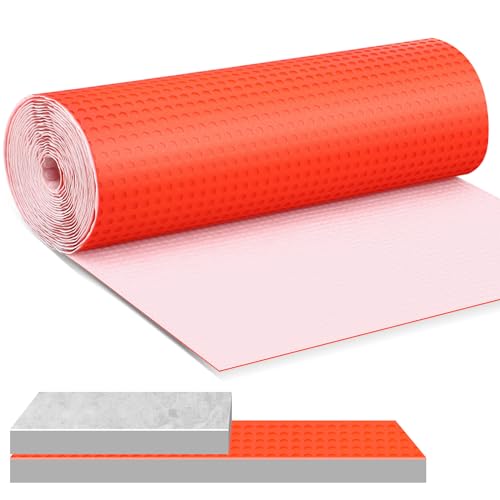
Uncoupling Membrane
Goes between the subfloor and tile to absorb small movement; it does not fix an undersized joist.
Subfloor Adhesive
Subfloor Adhesive
Gluing and screwing a second subfloor layer stiffens the floor between joists.
Check price on AmazonGluing and screwing a second subfloor layer stiffens the floor between joists.
Laser Level
Check the floor for sag and dips before you tile.
As an Amazon Associate I earn from qualifying purchases.
Prices as of Sep 30, 2026, 4:37 AM UTC. Product prices and availability are accurate as of the date/time indicated and are subject to change. Any price and availability information displayed on Amazon.com at the time of purchase will apply to the purchase of this product.
Do this math on the job site — in the free app
Smart Tile Calculator for Android: offline, in your pocket, free.
How this calculator works
The formula. A joist carrying an even load across a single span bends Δ = 5 w L⁴ ÷ (384 E I). w is the load on one joist in pounds per inch (floor load × joist spacing), L the clear span in inches, E the stiffness of the wood, and I the moment of inertia of the joist (1.5 × depth³ ÷ 12 for dressed lumber).
The limits. The TCNA Handbook and ANSI A108.02 set L/360 for ceramic and porcelain tile and L/720 for natural stone on wood framing, under live load. The IRC design live load for rooms in a house is 40 psf (Table R301.5).
Wood stiffness. E values are the American Wood Council's 2018 NDS Supplement figures for No. 2 lumber: Douglas Fir-Larch 1,600,000 psi, Southern Pine and Spruce-Pine-Fir 1,400,000, Hem-Fir 1,300,000.
Worked example. 2×10 Douglas Fir-Larch No. 2 at 16 in on centre over a 14 ft span at 40 psf: w = 40 × 16 ÷ 144 = 4.44 lb/in, I = 98.93 in⁴, so Δ = 0.29 in, or L/577. That passes L/360 for porcelain but fails L/720 for marble, which needs a span of 13 ft 0 in or less.
This checks solid-sawn joists only. The subfloor between joists is a separate check, and I-joists and trusses need the maker's deflection figures. For a structural change, ask an engineer.
Frequently asked questions
What is L/360 deflection?
The joist may bend no more than its span divided by 360 under live load. A 12 ft (144 in) span may deflect 0.4 in. It is the limit for ceramic and porcelain tile on wood framing in the TCNA Handbook and ANSI A108.02.
What deflection do I need for natural stone tile?
L/720, twice as stiff as ceramic. On a 12 ft span that is 0.2 in. Many floors that pass for porcelain need blocking, sistering or a shorter span before marble or slate.
Can 2x10 joists at 16 inches hold tile?
For porcelain, Douglas Fir-Larch No. 2 at 40 psf passes L/360 up to about 16 ft 4 in; for natural stone (L/720) up to about 13 ft. Southern Pine No. 2 is slightly less stiff: about 15 ft 8 in and 12 ft 5 in.
Does an uncoupling membrane fix a bouncy floor?
No. Membranes handle small in-plane movement between the tile and the subfloor; they do not stiffen the joists. The joists still need to meet the deflection limit.
How do I make my floor stiff enough for tile?
Shorten the span with a beam or wall below, sister new joists alongside the old ones, or add solid blocking. Enter the new span or joist size above to see the effect.
Related calculators
- Floor Tile CalculatorTiles and boxes for any floor, by room dimensions and tile size.
- Large Format Tile Calculator24-inch-plus tiles: counts, leveling clips, and handling extras.
- Tile Trowel Size CalculatorWhich notch for your tile size, mortar coverage to check for, and bags of thinset.
- Backer Board CalculatorCement board sheets, screws, and tape for floors and walls.
- Self-Leveling Compound CalculatorBags of leveler by area and depth of the low spots.
Guides worth reading next
- How to Measure a Room for Tile (Step by Step)Measure any room for floor or wall tile: handle closets and alcoves, convert inches to decimals, subtract fixtures, and add the right waste percentage.
- Choosing the Right Tile Size for Your RoomHow tile size changes a room: when 12×24 beats 4×4, why small rooms can take large tile, grout line math, and the flatness rule for big formats.
- Sanded vs Unsanded vs Epoxy Grout: Which One Do You Need?Grout types explained by joint width and location: when sand scratches tile, why epoxy wins in showers, and how much of each type a bag actually covers.