Guide · 7 min read
Waterproofing a Tiled Shower: The Layer Cake That Keeps Water Out
Why tile and grout are not waterproof, how sheet and liquid membranes work, where corners and niches fail, and the flood test you shouldn't skip.
Free calculator — runs in your browser, nothing is uploaded.
Tile is a finish, not a barrier
The single most expensive misconception in tiling: water that gets through grout just... goes away. It doesn't. Cement grout is porous, thinset is porous, and water migrates through both. Without a membrane, that water ends up in your studs and subfloor.
A proper tiled shower is a layer cake: studs, backer board, waterproof membrane, thinset, tile, grout. The tile is decoration. The membrane is the shower.
Sheet vs liquid membranes
Sheet membranes (Kerdi and similar) are thin polyethylene mats thinsetted to the backer board. They're foolproof on thickness — the sheet is the sheet — but seams and corners need careful overlapping with the manufacturer's band.
Liquid membranes (RedGard, Hydro Ban) roll or brush on like thick paint, usually two coats. They handle corners and niches gracefully, but coverage thickness is on you: too thin and pinholes let water through. Most pros measure with a wet-film gauge. The RedGard calculator turns your wall and floor area into gallons and pails at the maker's coverage rates.
Waterproofing supplies

Hard-to-Find Fastener Phillips Self-Piercing Cement Board Screws, Durable Steel Hardware Fasteners for Home Improvement, DIY, Construction, 8 x 1-1/4, Pack of 168
$11.11
Check price on Amazon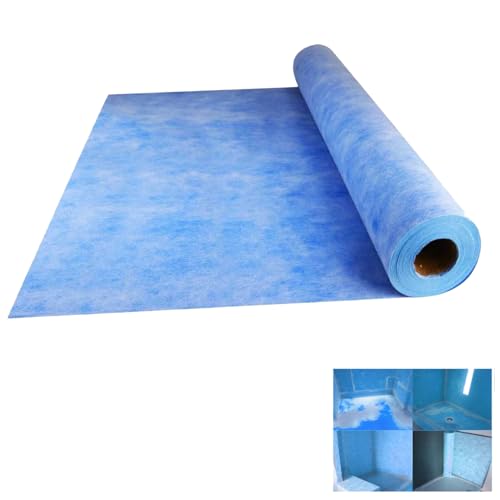
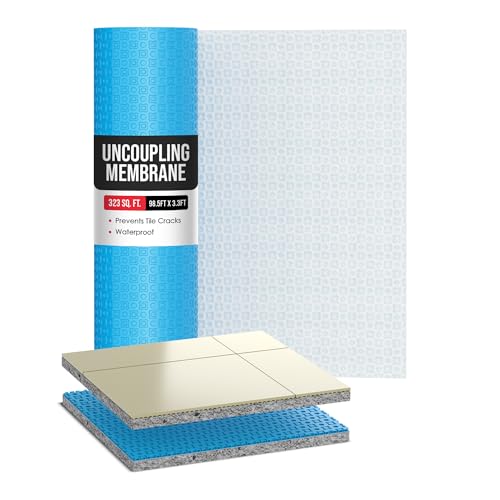
Kauwm Shower Waterproofing Membrane Roll, 3.3x98.5 FT, 323 Sq Ft, 23.6 Mil
$94.99
Check price on Amazon
As an Amazon Associate I earn from qualifying purchases.
Prices as of Oct 10, 2026, 6:33 AM UTC. Product prices and availability are accurate as of the date/time indicated and are subject to change. Any price and availability information displayed on Amazon.com at the time of purchase will apply to the purchase of this product.
Where showers actually leak
Failures cluster in predictable places: inside corners where walls meet, the wall-to-pan transition, around the valve and showerhead penetrations, and inside niches. Flat open walls almost never leak; geometry leaks.
Whatever system you use, pre-form or reinforce every corner and penetration with the manufacturer's corner pieces and sealant collars. This is where the extra hour of prep pays for the entire membrane. Niches are easier to seal when they are framed to whole tiles, which the shower niche size calculator works out from your tile and stud spacing.
The flood test
Before any tile goes on, plug the drain, fill the pan with an inch or two of water, mark the level, and wait 24 hours. A dropping level means a leak — find it now, when fixing it costs a patch, not a demolition. Building the pan yourself? Check its size against code with the shower pan size calculator, and the deck mud calculator gives the bags of mortar for the sloped bed.
Some jurisdictions require the flood test by code and a few want it inspected. Even where it's optional, skipping it is how you discover a pinhole leak through a ceiling stain downstairs.
- Membrane over the backer board, on every wet surface including the bench
- Reinforce corners, seams, penetrations and niches with band or fabric
- Slope the pan 1/4 inch per foot toward the drain before membrane goes down
- Flood test 24 hours before tiling
Choosing a membrane? See our shower waterproofing buying guide.
Do this math on the job site — in the free app
Smart Tile Calculator for Android: offline, in your pocket, free.
FAQ
Is cement backer board waterproof?
No — cement board is water-stable (it won't fall apart when wet) but water passes right through it. It still needs a membrane over it in a shower.
Can I waterproof over drywall in a shower?
Only with specific foam-board or coated systems rated for it. Regular drywall — even 'green board' — is not an acceptable substrate behind shower tile under modern codes.
How long does liquid membrane take to cure?
Typically 1–3 hours between coats and 12–24 hours before flood testing or tiling, depending on humidity. Dark pink-to-red (or gray-to-black) color change usually signals a cured coat.
Keep reading
- Modified vs Unmodified Thinset: The 30-Second Answer (and the Long One)
Use modified (ANSI A118.4) thinset for porcelain on most substrates; unmodified (A118.1) under Kerdi and Ditra. Neither is waterproof — here's why.
- The 7 Tile Mistakes That Show Up a Year Later
Skips that pass inspection on day one and fail by month twelve: no membrane, thin coverage, slivers at the doorway, wrong caulk, and more.