
Guide · 6 min read
Leveling a Floor for Tile: Flat vs Level, and How to Fix Both
Why tile needs flat (not level), the straightedge test, self-leveling compound basics, primers, and depth math that decides your bag count.
Free calculator — runs in your browser, nothing is uploaded.
Flat matters, level doesn't
A floor can slope noticeably and still take beautiful tile — tile doesn't care about gravity. What it can't tolerate is local unevenness: humps and dips that leave tile edges rocking and mortar beds uneven. The standard: flat within 1/4 inch over 10 feet for regular tile, 1/8 inch for large format.
Check with a 10-ft straightedge or long level, sliding it around in a grid and marking gaps with a pencil on the floor. Circle the lows; grind or fill the highs. Flatness is only half of it on a wood-framed floor: the floor deflection calculator checks that the joists are stiff enough for tile, and an uncoupling membrane over the subfloor is sized with the DITRA calculator.
Self-leveling compound: the 20-minute pour
Self-leveling underlayment (SLU) is a pourable cement that seeks its own level and fills the lows. It sounds magic and mostly is — but the prep is everything: the floor must be clean, sound, and primed, and every hole and gap must be dammed or the SLU pours into the room below.
Once mixed you have roughly 15–20 minutes of working time. Mix all your bags' worth of water in advance, stage the bags open, and pour in one continuous operation with a helper mixing. Stop halfway and you'll have a permanent ridge at the seam.
Prep materials for a flat floor

Hard-to-Find Fastener Phillips Self-Piercing Cement Board Screws, Durable Steel Hardware Fasteners for Home Improvement, DIY, Construction, 8 x 1-1/4, Pack of 168
$11.11
Check price on Amazon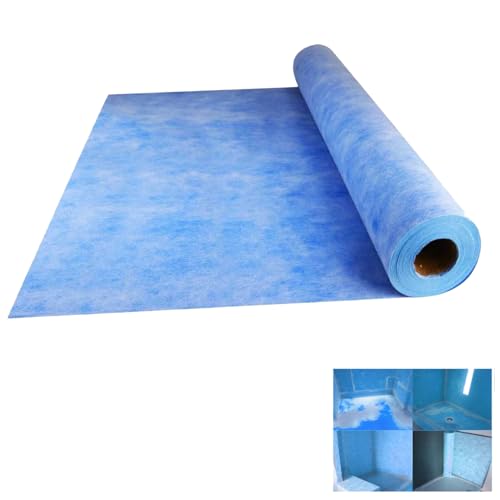
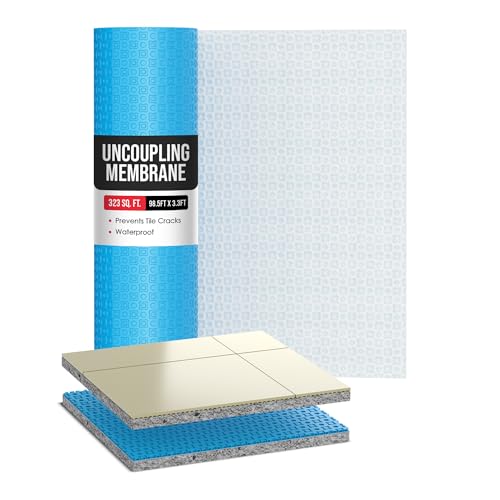
Kauwm Shower Waterproofing Membrane Roll, 3.3x98.5 FT, 323 Sq Ft, 23.6 Mil
$94.99
Check price on Amazon
As an Amazon Associate I earn from qualifying purchases.
Prices as of Oct 10, 2026, 6:33 AM UTC. Product prices and availability are accurate as of the date/time indicated and are subject to change. Any price and availability information displayed on Amazon.com at the time of purchase will apply to the purchase of this product.
Primer is not optional
SLU over unprimed concrete fails in the most expensive way: the slab drinks the mix water, the compound cures weak and powdery, and the whole layer debonds under your new tile. Primer costs little, rolls on in minutes, and is specified by every manufacturer.
On plywood, use the primer the SLU maker specifies for wood, and confirm the product is rated over wood at all — some are concrete-only.
Depth math
A 50 lb bag covers roughly 50 sq ft at 1/8 inch — but floors rarely need a uniform 1/8. Estimate the average depth across the low areas, not the deepest point. A dip 3/8 inch deep over a third of the room averages 1/8 inch overall.
SLU cures walkable in hours but needs its full cure before tile — often 24–72 hours, and moisture-sensitive tile may need a moisture test first. Read the bag; the calendar is part of the product.
Do this math on the job site — in the free app
Smart Tile Calculator for Android: offline, in your pocket, free.
FAQ
Can I use thinset to level a floor?
Thinset can patch small spots (feather to 1/2 inch with the right product), but it's not pourable and can't level an area. Beyond spot fixes, use SLU or deck mud.
How thick can self-leveler go?
Most standard products handle 1/8 to 1 inch per pour, with extended versions going to 2+ inches. Deeper fills need aggregate added or a second pour after the first cures.
Why did my self-leveler crack or crumble?
The usual suspects: skipped primer, too much mix water, a dirty or moving substrate, or tiling before full cure. SLU is unforgiving about its instructions — follow them literally.
Keep reading
- Avoiding Lippage on Large-Format Tile
What causes one tile edge to sit higher than the next, the 1/8-in-in-10-ft flatness rule, why 50% offsets are banned on plank tile, and how leveling clips help.
- Large-Format Tile: Is Your Floor Flat Enough?
The 1/8-in-in-10-ft rule, why 15-inch tile changed the standards, how to test your slab with a straightedge, and what fixing it costs.